

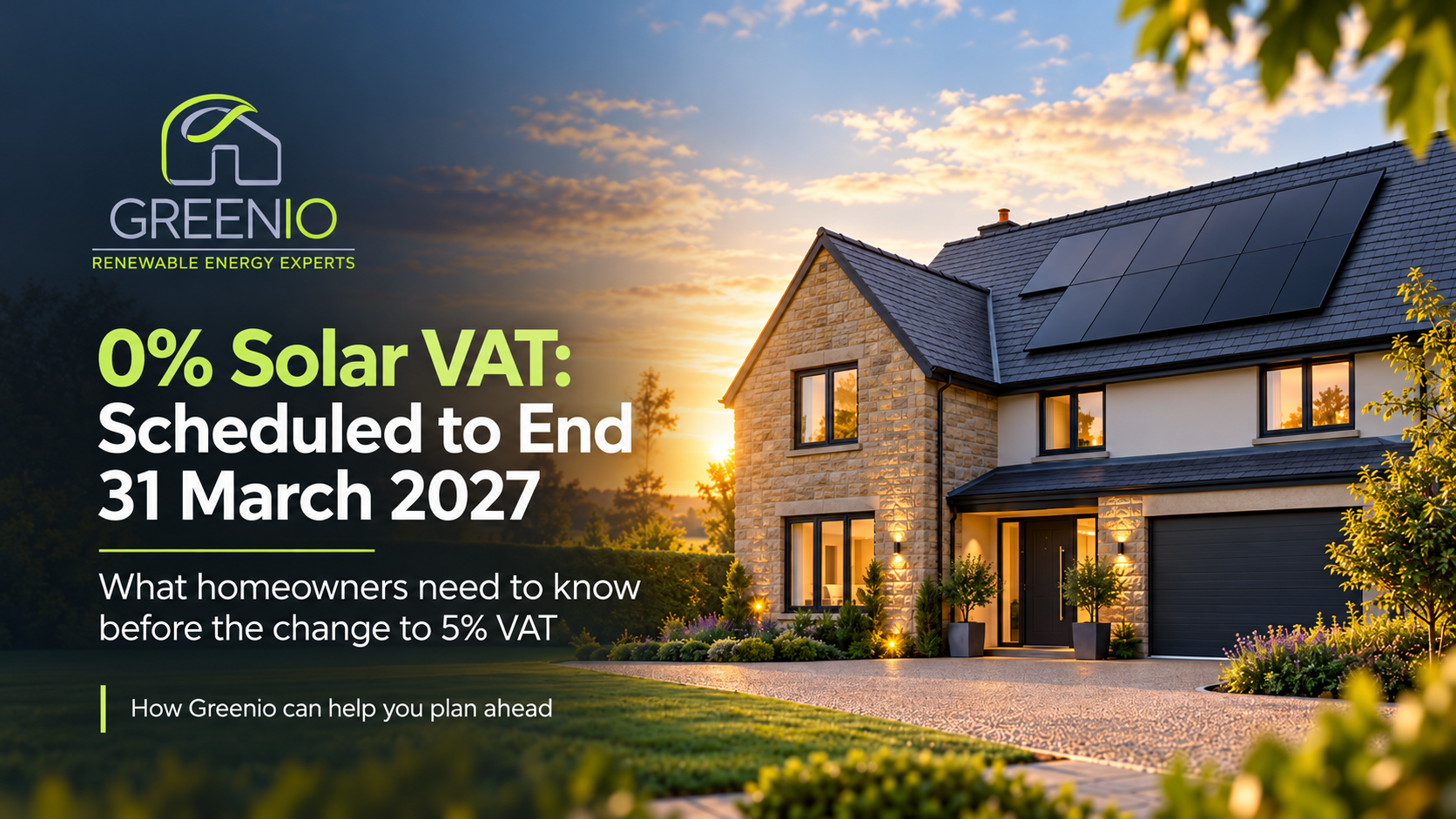
The current VAT relief on domestic solar panels and battery storage is due to end on 31 March 2027. Here’s what the changes could mean for your home, how much more a solar installation might cost, and why planning ahead could make a real financial difference.
If you’ve been considering installing solar panels or battery storage at your home, the coming months could be an important time to act.
Under current UK legislation, qualifying domestic solar PV and battery storage installations benefit from 0% VAT until 31 March 2027.
From 1 April 2027, the VAT rate is scheduled to increase to 5%, unless the government announces an extension or further changes.
For homeowners across Lincolnshire, Nottinghamshire and the wider East Midlands, that could mean paying hundreds of pounds more for exactly the same renewable energy system.
At Greenio, we believe homeowners should have the information they need to make an informed decision, rather than feeling pressured into rushing an investment.
Here’s what you need to know.
Why is the 0% VAT relief ending?
In April 2022, the UK government introduced a temporary zero rate of VAT on the professional installation of qualifying energy-saving materials in residential properties.
The initiative was designed to make technologies such as solar panels more affordable, encourage improvements in household energy efficiency and support the transition towards cleaner energy.
The relief was subsequently expanded in February 2024 to include qualifying standalone electrical battery storage systems, allowing homeowners with existing solar installations to benefit when adding batteries.
However, the zero rate was introduced as a temporary measure.
HM Revenue & Customs (HMRC) currently confirms that qualifying installations will return to the reduced rate of 5% VAT from 1 April 2027.
Importantly, this is not an increase to the standard 20% VAT rate for qualifying installations. The reduced 5% rate is scheduled to apply instead.
The government has retained the option to extend the 0% VAT period, but homeowners should not assume that an extension will be announced.
How much more could solar panels cost after March 2027?
The financial impact will depend on the size and specification of your installation.
The table below illustrates what the proposed change from 0% to 5% VAT could mean, assuming the underlying installation price remains unchanged.
| Installation cost excluding VAT | Cost at 0% VAT | Cost at 5% VAT | Additional cost |
|---|---|---|---|
| £6,000 | £6,000 | £6,300 | £300 |
| £8,000 | £8,000 | £8,400 | £400 |
| £10,000 | £10,000 | £10,500 | £500 |
| £12,000 | £12,000 | £12,600 | £600 |
| £15,000 | £15,000 | £15,750 | £750 |
| £20,000 | £20,000 | £21,000 | £1,000 |
For example, a homeowner investing £15,000 in a professionally installed solar PV and battery storage system could face an additional £750 in VAT from April 2027.
That is £750 which could otherwise contribute towards additional battery capacity, system monitoring or simply remain in the homeowner’s pocket.
Of course, the real value of a well-designed solar installation extends far beyond the initial VAT saving.
By generating electricity at home, storing surplus energy and reducing dependence on purchased electricity, homeowners can potentially make significant savings over the lifetime of their system.
Does the VAT change affect battery storage too?
Yes.
The current 0% VAT relief covers qualifying professionally installed electrical battery storage systems, including:
- Battery storage installed alongside new solar panels.
- Batteries retrofitted to existing solar PV installations.
- Qualifying standalone home batteries designed to store electricity from the grid.
These qualifying installations are also scheduled to move to 5% VAT from 1 April 2027.
This is particularly relevant for homeowners who already have solar panels but are considering adding battery storage.
A battery can allow households to retain more of the electricity they generate during the day and use it in the evening, when demand is often higher.
Certain systems can also charge from the grid during cheaper electricity tariff periods, potentially improving the financial return.
At Greenio, we assess existing solar installations before recommending additional storage to ensure that battery capacity, inverter compatibility and energy usage are properly considered.
What do homeowners need to do before 31 March 2027?
The safest approach for homeowners wishing to benefit from the current 0% VAT relief is to arrange for their qualifying installation to be completed before 31 March 2027.
It is important to understand that accepting a quotation or paying a deposit before the deadline does not automatically guarantee that the entire installation will qualify for 0% VAT.
HMRC applies specific VAT tax-point rules, which can depend on when payments are made, invoices are issued and installation work takes place.
This is why planning ahead matters.
A professionally designed solar and battery installation involves more than simply selecting panels and arranging a convenient installation date.
An installer may need to assess your roof, review electricity consumption, complete system designs, confirm electrical capacity, arrange any necessary distribution network operator approvals and order specialist equipment.
Leaving these decisions until the final weeks of March could introduce unnecessary pressure and limit installation availability.
Our recommendation is to begin planning well ahead of the deadline, allowing sufficient time for a properly designed, compliant installation.
Will there be new grants or incentives to replace 0% VAT?
The government has announced further support for household energy efficiency through its Warm Homes Plan.
However, there is currently no confirmed universal replacement for the 0% VAT relief that guarantees an equivalent saving for every homeowner installing solar panels.
The Warm Homes Plan does include several measures that could help households invest in renewable energy.
New low- and zero-interest home improvement loans
The government has outlined plans for new low- and zero-interest consumer loans to help households meet the upfront cost of improving their homes.
These measures are intended to make home upgrades, including eligible clean energy technologies, more accessible.
However, the availability, eligibility and final terms of these schemes will depend on their implementation.
Homeowners should therefore avoid assuming they will automatically qualify for government-backed finance.
Warm Homes: Local Grant
Some eligible lower-income households in England may already qualify for fully funded energy efficiency improvements through the Warm Homes: Local Grant.
Depending on the property, local funding and individual circumstances, these improvements can include solar panels.
Eligibility is generally linked to household income, location and the property’s Energy Performance Certificate (EPC).
This is not a universal grant available to every homeowner, but it may offer significant support to qualifying households.
Smart Export Guarantee
The Smart Export Guarantee (SEG) is another important consideration.
Eligible homeowners with solar PV systems can receive payments from participating electricity suppliers for surplus electricity exported to the grid.
The amount paid varies depending on the supplier and tariff selected.
Although the SEG is not a replacement for the VAT relief, it can contribute to the overall financial return of a solar installation.
Combining solar generation, suitable battery storage, smart energy tariffs and export payments can help homeowners make better use of their investment.
Why choosing the right installer matters more than ever
With changes to VAT on the horizon, it may be tempting to focus solely on getting solar panels installed before the deadline.
However, choosing the right system and installation partner is equally important.
A poorly specified installation could cost considerably more over its lifetime than any initial VAT saving.
At Greenio, we take an engineering-led approach to renewable energy.
Rather than offering a standard package for every household, we consider your property’s requirements, electricity usage, future energy needs and financial objectives before recommending a solution.
Our approach includes:
- Bespoke system design: Solar PV and battery storage solutions developed around your property and energy consumption.
- Experienced, qualified installers: Professional installations carried out with attention to safety, workmanship and presentation.
- MCS-certified installation: Installation processes designed to meet applicable industry standards and certification requirements.
- Premium technology: Carefully selected solar panels, inverters and battery storage systems from established manufacturers.
- Financial considerations: Clear explanations of potential savings, system performance and available finance options.
- Long-term support: Continued advice, aftercare and support beyond the initial installation.
As part of the TLS Energy Group, Greenio combines the experience and technical expertise of an established energy business with the personal service customers expect from a local installation specialist.
Why now is a good time to consider solar
The approaching VAT change provides a financial reason to review your options, but it shouldn’t be the only consideration.
A well-designed solar and battery storage system can provide long-term benefits, including reduced reliance on electricity purchased from the grid, improved control over household energy use and greater protection against future electricity price increases.
For households considering electric vehicles, battery storage or other electrical technologies, planning the right system today can also help prepare the property for future requirements.
The important point is to make the decision based on your individual circumstances, rather than rushing into a system simply to meet a tax deadline.
Talk to Greenio about your solar installation before March 2027
If you’ve been thinking about investing in solar panels or battery storage, now is a sensible time to explore your options.
Greenio works with homeowners throughout Newark, Nottinghamshire, Lincolnshire, Leicestershire and the wider East Midlands, providing individually designed renewable energy solutions.
We’ll take the time to understand your home, explain the available technologies and help you assess the potential financial benefits.
We can also discuss installation timescales and how the current VAT rules may affect your planned investment.
Don’t leave your solar investment until the last minute.
Contact Greenio today for a no-obligation discussion about solar panels and battery storage, and find out how you could benefit from the current 0% VAT relief before the scheduled change.
Tax information correct as at 22 October 2026 and subject to government changes. VAT treatment depends on the circumstances and relevant tax-point rules. Financial savings and system performance vary by property, usage and system specification.