
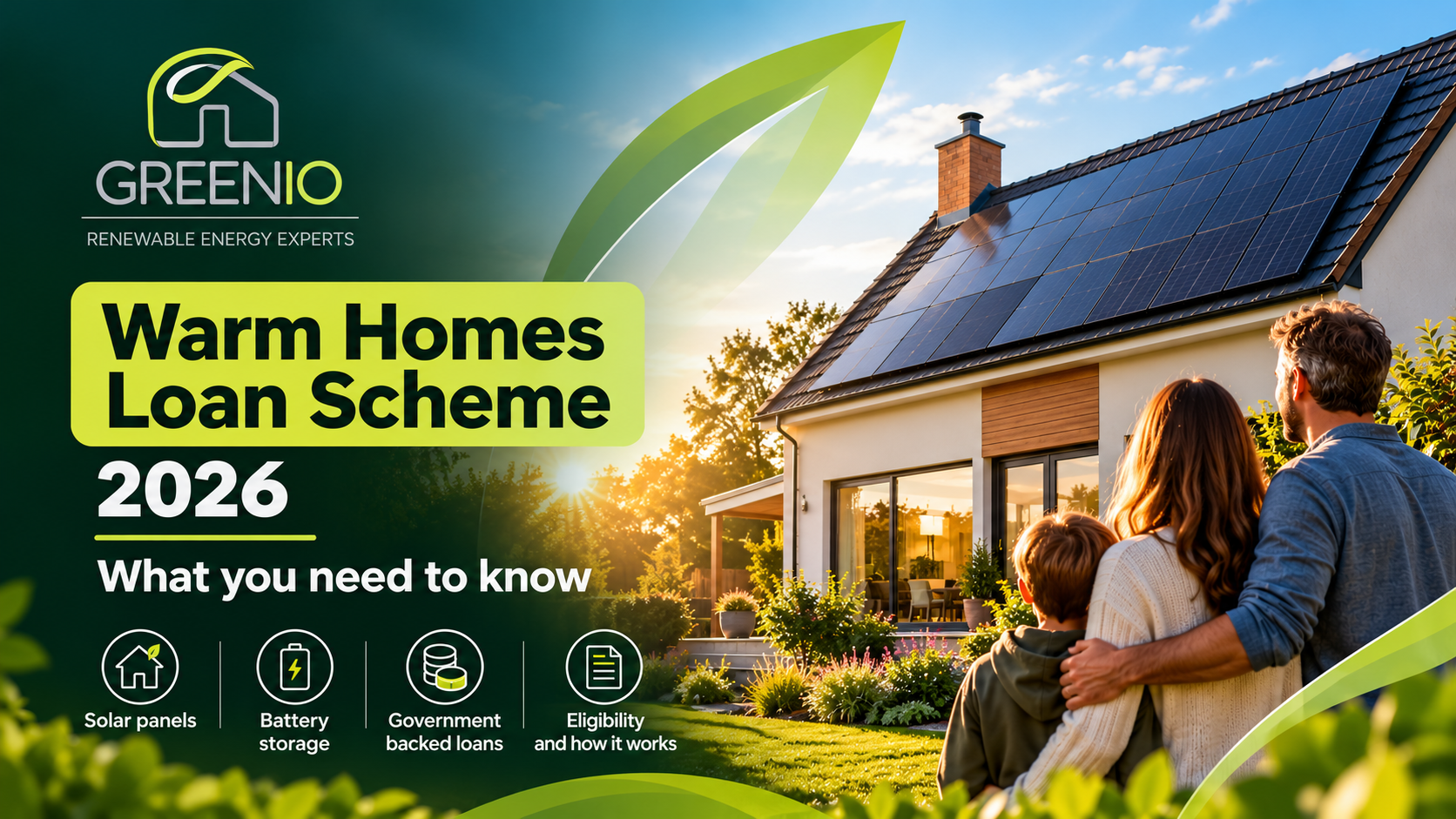
Could you install solar panels and battery storage with no upfront payment and benefit from lower interest rates?
The Government’s new Warm Homes Loan Scheme (WHLS) could make it easier and more affordable for homeowners to invest in solar panels, battery storage and other energy-saving improvements.
Announced on 27 October 2026, the scheme introduces government-backed loans with 0% and reduced interest rates, helping households spread the cost of renewable energy installations rather than paying thousands of pounds upfront.
And there’s good news for Greenio customers.
Greenio will be able to offer access to the Warm Homes Loan Scheme through our existing finance partner, Ideal4Finance, which is working with participating lender Propensio.
The final finance products and application arrangements are currently being confirmed, but this is an exciting development for homeowners looking to reduce their energy bills without making a large initial investment.
So how does the scheme work? Who qualifies? Are the loans really interest-free? And could solar panels save you more than the monthly repayments?
Here, we explain everything you need to know in straightforward terms, including the benefits, potential drawbacks and questions you should ask before committing.
What Is the Warm Homes Loan Scheme?
The Warm Homes Loan Scheme is a new Government initiative designed to help homeowners make their properties cheaper to run by providing access to more affordable finance.
Instead of paying the full cost of solar panels or battery storage upfront, eligible homeowners can spread the cost over monthly repayments.
The Government is working with approved lenders to provide interest-free and lower-interest loans, making borrowing more affordable than many conventional finance arrangements.
The scheme supports several home energy improvements, including:
- Solar panels to generate your own electricity.
- Battery storage to save electricity for use later.
- Air source and ground source heat pumps.
- Other eligible renewable energy technologies.
The scheme is available across the UK, including England, Scotland, Wales and Northern Ireland.
The important point: This is a loan, not a grant. You still repay the money you borrow, but the lower interest rates could make renewable energy more accessible.
You can find further information in the official Government Warm Homes Loan Scheme factsheet.
How Much Can You Borrow for Solar Panels?
The Government has confirmed the following maximum supported loan amounts:
| Home improvement | Maximum supported loan |
|---|---|
| Solar panels | £15,000 |
| Home battery storage | £15,000 |
| Air source heat pump (air-to-water) | £20,000 |
| Ground source heat pump | £35,000 |
You may be able to finance more than one improvement, such as solar panels and battery storage together.
For many households, this could cover a substantial proportion, or potentially all, of the installation cost.
However, the amount you can borrow will depend on the lender, the cost of the work and your personal financial circumstances.
Can You Really Get 0% Interest on Solar Panels?
Yes, some participating lenders are offering interest-free loans under the Warm Homes Loan Scheme.
However, not every loan will be interest-free and not every homeowner will qualify for the same terms.
The Government says participating lenders can offer interest rates up to five percentage points lower than comparable conventional borrowing.
The exact interest rate and repayment period will depend on the lender and the finance product available to you.
You can also explore Greenio’s residential finance options to understand the payment arrangements currently available.
How Much Difference Could Cheaper Finance Make?
Let’s look at a simple example.
Imagine you want to borrow £10,000 for a solar panel and battery installation, with repayments spread over seven years.
| Interest rate | Approx. monthly repayment | Total repaid |
|---|---|---|
| 10.9% APR | £170 | £14,281 |
| 5% APR | £141 | £11,872 |
| 3% APR | £132 | £11,097 |
| 0% APR | £119 | £10,000 |
These are illustrative figures, not actual Warm Homes Loan Scheme offers. They assume fixed repayments and no additional fees.
As you can see, reducing the interest rate can make a significant difference.
But remember, 0% interest is not guaranteed, and the lowest monthly payment isn’t always the cheapest option if the loan is spread over a much longer period.
Who Qualifies for the Warm Homes Loan Scheme?
One of the biggest advantages is that the scheme isn’t exclusively for people receiving benefits or households on low incomes.
To qualify under the Government’s basic rules:
- You must own your home, either outright or with a mortgage.
- Your property must be residential and located in the UK.
- You must use the loan for eligible energy-saving improvements.
- You must meet the lender’s credit and affordability requirements.
- Your installation must normally be completed by an MCS-certified installer.
This means many ordinary homeowners who previously found the upfront cost of solar panels difficult may now have another finance option.
However, approval is not automatic, and individual lenders may have additional requirements.
For full details, read the Government’s official Warm Homes Loan Scheme eligibility guidance.
How Much Could Solar Panels Save on Your Electricity Bills?
Solar panels allow you to generate electricity from daylight rather than purchasing all your electricity from your energy supplier.
When combined with battery storage, you can also save some of the electricity generated during the day to use in the evening.
This can help reduce the amount of electricity you need to buy from the grid.
The Government has suggested that installing solar panels, battery storage and a heat pump together could save households up to £550 a year on energy bills, with potentially a further £300 through a suitable time-of-use electricity tariff.
These are Government estimates for a combination of technologies, not guaranteed savings from solar panels alone.
Your actual savings will depend on:
- How much electricity your household uses.
- The size and position of your solar panels.
- Whether you have battery storage.
- Your electricity tariff.
- How much solar electricity you use rather than export.
- The cost of the installation.
At Greenio, we believe the most important thing is understanding what a system could realistically save in your home, rather than relying on general savings claims.
That’s why we recommend a proper property survey and a system designed around your household’s electricity usage.
Planning a solar installation?
Talk to Greenio


Contact us about your project
Could Your Energy Savings Help Pay for the Loan?
Potentially, yes.
One of the attractions of lower-interest solar finance is that your monthly electricity savings could help offset your monthly repayments.
For example:
Imagine a £10,000 solar and battery installation financed at 0% interest over ten years.
Your monthly repayment would be approximately £83.
If the system provided an average financial benefit of £900 a year through reduced electricity purchases and export payments, that would be equivalent to £75 per month.
In this example, the estimated financial benefit would cover most of the repayment.
Once the loan is repaid, the system could continue generating electricity and providing savings for years afterwards.
However, this isn’t guaranteed.
If your system produces less electricity than expected, electricity prices change or your household uses more energy at different times, the financial return may be lower.
You should also allow for maintenance and possible equipment replacement costs over the system’s lifetime.
Our advice is simple: never take out solar finance based solely on a promise that the panels will pay for themselves. Make sure the figures work for your property and your budget.
What Are the Downsides of the Warm Homes Loan Scheme?
Although we welcome the scheme, homeowners should understand the potential drawbacks.
It Is Still Borrowing
Even with 0% interest, you are taking on a financial commitment. Monthly repayments must remain affordable alongside your other household expenses.
Not Everyone Will Get 0%
The availability of interest-free finance will depend on the lender, product and eligibility requirements.
Longer Repayment Terms May Cost More
Some lenders offer repayment periods of up to 30 years.
That may reduce the monthly payment, but if interest is charged, it could increase the total amount you repay.
Your Savings May Not Match Your Repayments
Solar panels can reduce electricity bills, but savings depend on the system, the property and how you use electricity.
Not Every Lender Offers the Same Conditions
Some lenders work with selected installers, while others may allow you to choose any appropriately MCS-certified installer.
You should compare interest rates, total repayment costs, fees and early repayment conditions.
Check Whether the Loan Is Secured
Different lenders may offer different types of borrowing. If finance is secured against your property, you need to understand the consequences of missed repayments, including the potential risk to your home.
Check the Installation Price
A lower interest rate doesn’t automatically mean you’re getting the best deal.
Compare the actual installation cost as well as the finance terms. Don’t assume that a government-backed loan means the installation itself is government-approved or the cheapest available.
Can You Get a Government Grant Instead?
Possibly, depending on your circumstances and the improvements you want to make.
The Warm Homes Loan Scheme is separate from Government grants.
Some households, particularly those on lower incomes, may qualify for other assistance that could be more beneficial than taking out a loan.
There are also specific grants for eligible heating improvements, such as the Boiler Upgrade Scheme.
Before committing to finance, it is worth checking whether grant support is available to you.
Will Solar Panels Become More Expensive in April 2027?
This is another important consideration for anyone thinking about installing solar panels.
The current 0% VAT relief on qualifying domestic solar panel and battery installations is scheduled to end on 31 March 2027, with the rate increasing to 5% from 1 April 2027.
For example, a £12,000 installation before VAT would cost £600 more if the full installation became subject to 5% VAT.
This means homeowners considering solar should look at both the timing of their installation and the finance options available.
However, don’t rush into an installation simply because of a tax deadline.
Make sure the system is suitable, the price is competitive and the savings have been properly explained.
VAT treatment depends on the relevant HMRC rules and the timing of the transaction. Paying a deposit before the deadline does not automatically secure 0% VAT on the whole installation.
How Can You Access the Warm Homes Loan Scheme Through Greenio?
Greenio is already partnered with Ideal4Finance, helping eligible customers access finance for renewable energy installations.
Following the Government’s announcement, Ideal4Finance has confirmed that it will be offering access to the Warm Homes Loan Scheme through participating lender Propensio.
This means Greenio customers will have a route to apply for the new scheme once the finance products and application arrangements are finalised.
Here’s how we can help.
Step 1 – Talk to Greenio
Tell us about your home, your electricity bills and what you would like to achieve.
Step 2 – Arrange a Free Home Survey
We’ll assess your property’s suitability for solar panels and battery storage and discuss what system could work best for you.
Step 3 – Receive a Tailored Proposal
We’ll provide a quotation and explain the estimated electricity generation, potential savings and installation options.
Step 4 – Explore Your Finance Options
Through our finance partner Ideal4Finance, we’ll be able to explain how to access the Warm Homes Loan Scheme when the new offering is available.
Any application will be subject to the participating lender’s terms, eligibility and approval.
Step 5 – Professional Installation and Ongoing Support
If you decide to proceed, our team will manage your installation and provide the ongoing support you need.
There’s no obligation to proceed following your initial enquiry or survey.
Visit our contact page to arrange your free home survey or learn more about financing your installation.
Planning a solar installation?
Talk to Greenio
Contact us about your project
Warm Homes Loan Scheme FAQs – Your Questions Answered
1. Is the Warm Homes Loan Scheme available now?
The Government launched the scheme in October 2026, with ten initial participating lenders. Individual products and application routes are being introduced by those lenders.
Greenio’s finance partner Ideal4Finance has confirmed it will offer access through Propensio. The final arrangements for Greenio customers are currently being completed.
2. Can I get free solar panels through the scheme?
No. The scheme provides loans, not free solar panels. Some loans may be interest-free, but you still have to repay the amount borrowed.
3. Can I get solar panels with no deposit?
Potentially. The Government says the scheme can enable eligible homeowners to install energy-saving technology without an upfront payment. This will depend on the lender’s product and whether the finance covers the full installation cost.
4. Do I need a good credit score?
Lenders will assess your credit history and whether you can afford the repayments. There isn’t one universal credit-score requirement for every participating lender.
5. Can pensioners apply?
Yes, homeowners of different ages may be eligible, although individual lenders may apply age, income and affordability requirements.
6. Can I apply if I still have a mortgage?
Yes. You do not need to own your home outright. However, some types of finance may have additional mortgage-related requirements.
7. Can I use the loan for solar panels and a battery together?
Yes. The scheme allows applications for more than one eligible improvement. The amount available will depend on the lender and your circumstances.
8. Can I get a loan just for battery storage?
Yes. Battery storage is one of the technologies covered by the scheme, so you may be able to finance a battery without installing new solar panels.
9. Can I use the scheme if I already have solar panels?
Potentially. If you want to add eligible battery storage or make another qualifying improvement, you may be able to apply. Your existing equipment will need to be assessed for compatibility.
10. Will the Government pay my monthly repayments?
No. The Government supports the availability of cheaper finance, but you remain responsible for repaying the loan.
11. Will solar panels work in winter?
Yes. Solar panels generate electricity from daylight, not just direct sunshine. However, they generally produce less electricity during shorter, darker winter days.
12. Will solar panels and a battery mean I never pay an electricity bill again?
Not necessarily. Most homes will still need to purchase some electricity from the grid and pay standing charges. The aim is to reduce your electricity costs, not promise that bills will disappear.
13. What happens if I sell my house before the loan is repaid?
This depends on your finance agreement. Some loans may need to be repaid when you sell, particularly where borrowing is secured against the property. Check the conditions with your lender.
14. Can I repay the loan early?
That depends on the lender. Some products may allow early repayment without charges, while others may have restrictions or fees.
15. Do I have to use a Government-approved solar installer?
For solar panels and battery storage, the scheme normally requires an MCS-certified installer. Greenio holds MCS certification for its relevant renewable energy installation work.
16. Is the Warm Homes Loan Scheme better than paying cash?
Not always. Paying cash avoids borrowing costs, while finance allows you to retain savings and spread the cost. The best choice depends on the interest rate, total amount repayable and your personal finances.
17. Can Greenio help me apply for the scheme?
Yes. Greenio will be able to offer access through Ideal4Finance and participating lender Propensio once the final arrangements are in place.
In the meantime, we can discuss your property, provide a quotation and help you understand whether solar panels and battery storage could be suitable.
Why Choose Greenio for Your Solar Panel Installation?
Choosing the right installer is just as important as choosing the right finance.
Greenio is a local renewable energy company based in Long Bennington, serving homeowners throughout Nottinghamshire, Lincolnshire, Newark, Grantham, Sleaford, Lincoln, Leicester, Derbyshire and the wider East Midlands.
We believe every installation should be designed around the property and the people living in it.
When you choose Greenio, you benefit from:
- MCS-certified installation by an experienced renewable energy team.
- Free, no-obligation home surveys with straightforward, practical advice.
- Bespoke solar and battery systems designed around your household.
- Clear financial information to help you understand potential savings.
- Access to finance options, including the forthcoming Warm Homes Loan Scheme offering through Ideal4Finance.
- Six-year workmanship protection on qualifying installations, alongside applicable manufacturer warranties.
- Local support and aftercare from a team you can contact after installation.
We are proud to have been Highly Commended in the Regional Solar PV Installer category at the 2026 East Midlands Energy Efficiency Awards.
Whether you are looking to install solar panels for the first time, add battery storage to an existing system or simply understand what your roof could generate, we’re here to help.
Ready to Find Out What Solar Could Save You?
The new Warm Homes Loan Scheme could open the door to renewable energy for thousands of homeowners who previously felt the upfront cost was too high.
With Greenio preparing to offer access through Ideal4Finance, now is a good time to explore your options.
Book your free, no-obligation home survey with Greenio today.
We’ll help you understand what’s suitable for your home, what it could cost, how much electricity you could generate and what finance options may be available.
Greenio – Your Local Renewable Energy Experts.
Finance is subject to status, affordability, lender approval and terms and conditions. Greenio introduces customers to finance through Ideal4Finance. The WHLS offering through Ideal4Finance and Propensio is being finalised, and rates and product availability have not yet been confirmed. Savings illustrations are estimates and are not guaranteed.